CMS - AI Integration Policy Framework - 2025-2028

    AI that augments human cognition - not replaces it.

    The collective vision that emerged from all stakeholders: AI must serve as an enabler of learning. AI engagement rests on three non-negotiable pillars - academic integrity, critical thinking, and ethical responsibility.

    Explore the five steps
    Classroom photo
    "Think First. Use Wisely.
    Reflect Always."The school AI learning ethos

    Academic integrity

    AI use must be acknowledged and documented by students and teachers alike.
    Critical thinking

    Tasks are attempted independently first; AI outputs are questioned and verified.

    Ethical responsibility

    Everyone engages with the technology ethically and transparently.

    The theoretical model
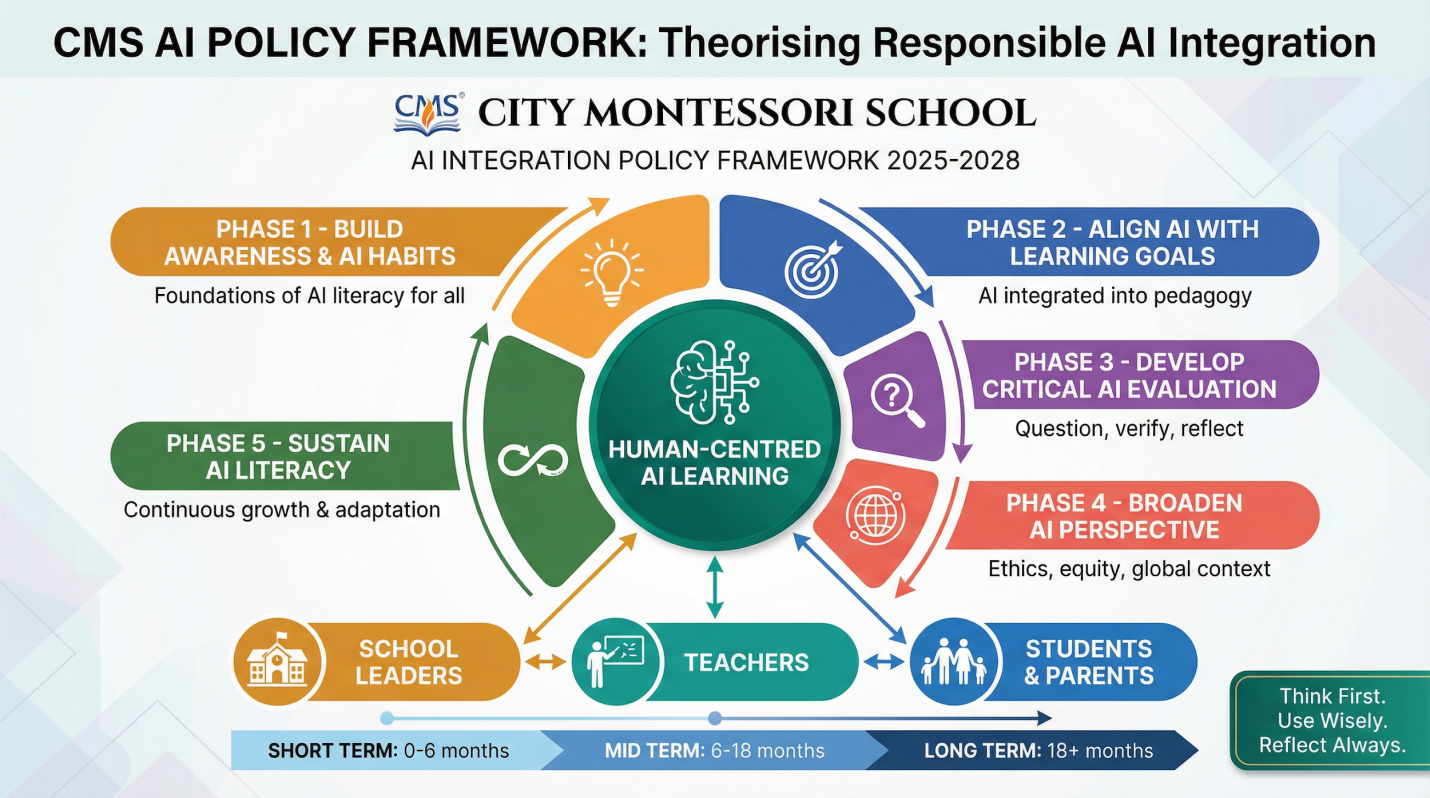
    What is Human-Centred AI Learning?

    This approach places intellectual and ethical development at the core of technological integration. The model is operationalised through the Think-Use-Reflect pedagogical cycle and requires synchronised action from school leaders, teachers, students, and parents.
    CMS AI Policy Framework diagram for responsible AI integration

    The pedagogical cycle

    Think. Use. Reflect.

    Every AI engagement begins with human inquiry and must always conclude with human evaluation.
    01 - Human inquiry

    Think

    Engage critical thinking first. Attempt tasks independently and formulate your own questions before turning to AI.

    03 - Human synthesis

    Reflect

    Conclude with human evaluation. Critically assess the AI output, verify facts, and synthesise information into original understanding.

    Steps towards AI policy

    Five progressive implementation steps.

    Step 1 of 5

    Build awareness & AI habits

    The foundation of responsible AI integration begins with establishing a shared understanding of what AI is, its capabilities, its limitations, and the ethical expectations surrounding its use. This phase focuses on developing fundamental AI literacy and establishing positive habits before moving to advanced applications.
    Transparency is non-negotiableAll use of AI must be acknowledged and documented by students and teachers alike.
    Process over productThe focus must remain on how a student arrives at an answer, rather than just the final submission.
    AI as a tutor, not a proxyAI should clarify concepts, not become a shortcut to bypass intellectual effort.
    School leadersPublish acceptable-use guidelines, integrate them into the student handbook, organise orientation sessions, and communicate the policy to parents.
    TeachersTeach how AI works at a basic level, demonstrate acceptable and unacceptable use, and begin using the Think-Use-Reflect model in daily instruction.
    Students & parentsCommit to acceptable-use guidelines and attend awareness workshops so AI supports genuine learning rather than replacing effort.

    Synchronised action

    Each stakeholder plays an irreplaceable role.

    The success of this policy relies on the collective commitment of school leaders, teachers, students, and parents. When these roles are fulfilled in concert, the school nurtures learners who use AI wisely and remain independent thinkers.
    Workshop photo

    School leaders

    Provide the vision and infrastructure, setting the boundaries within which AI engagement takes place.

    Teachers

    Learn, model, and facilitate, serving as the primary role models for responsible AI use.

    Students & parents

    Students engage with curiosity and integrity; parents reinforce responsible technology use at home.

    Appendix - quick reference

    AI acceptable use, at a glance.

    Acceptable use

    • Concept clarification and doubt-solving
    • Idea generation and brainstorming
    • Language support: grammar and vocabulary
    • Practice and self-assessment
    • Research support with verification
    • Generating practice questions
    • Exploring alternative perspectives

    Unacceptable use

    • Submitting AI-generated work as one's own
    • Using AI during assessments without permission
    • Copy-pasting answers without understanding
    • Over-reliance that reduces independent thinking
    • Using AI to avoid engaging with the material
    • Sharing confidential school data with AI tools
    • Using AI to generate false citations or sources

    Preparing future-ready learners and teachers

    "Think First. Use Wisely. Reflect Always."

    Not merely passive consumers of AI, but active, ethical, and critical thinkers - prepared to lead in a technology-driven future without losing their human judgement.